This is great news.. Kudos to Google for taking this initiative.. I hope it is successful and results in eye opener for US government. It has to be done.. sooner or later.. better we do it sooner and realize this potential..
It will be really interesting to watch the use cases coming out of this. Let us see, how city and its residents and hopefully young enterprising companies come up with to utilize this blazing fast internet pipe. Definitely most advantage will be in pervasive video applications and related areas. Off course Kansas City will be limited by non availability of Gigi internet on other side. But thye can definitely set up streaming services to take advantage of great upload service. Local LAN based applications will also be worth watching. With this speed, entire Kansas City should only have high def video phones or even 3D Halo type of video connectivity instead of POT (Plain Old Telephone) service.
Gaming industry should come up with more intuitive 3D type of Games where they can project other side as a Halo so you can really feel that you are playing with each other instead of playing with TV/LCD Display. I am sure, it is still early.. but once more and more Kansas Cities start coming up they will be come reality.
Cheers!!!
Some cities had used gimmicks to get the company’s attention. Topeka informally renamed itself “Google, Kansas.” A group in Baltimore launched a website that used Google’s mapping service to plot the location of more than 1,000 residents and give their reasons for wanting the service. Hundreds of groups on Facebook implored Google to come to their cities. The $70 monthly fee will pay for “gigabit” Internet service, about 100 times faster than a basic cable modem. For an additional $50 a month, Google will provide cable-TV-like service over the fiber, too, and a tablet computer that works as a remote.
The channel lineup includes Nickelodeon, Discovery, Bravo, Starz and Showtime (which may require additional fees) but is missing AMC, HBO, CNN, Fox News and ESPN. Google spokeswoman Jenna Wandres wouldn’t say why the channels were missing, but said the lineup would expand.
Google said it will start hooking up households in neighborhoods only where a sufficient number of people want service. Kansas City residents have six weeks to preregister for service, after which Google will decide which areas have enough interest.
Google will also offer a slower Internet option, at a DSL-like 5 megabits per second, with no monthly fee to households that pay a $300 installation fee. The free service is guaranteed for at least seven years, but is available only in neighborhoods where enough people have preregistered.
The $70 fee is more than what cable or phone companies charge for basic Internet service, but the service is also much faster. Gigabit speeds, or 1,000 megabits per second, are generally unavailable from other companies. One exception is the city-owned electric utility in Chattanooga, Tenn., which has pulled its own fiber and sells gigabit service for $350 a month.
Kansas City, Mo., Mayor Sly James, who attended the news conference Google held in a converted yoga studio in midtown Kansas City, was clearly pleased with the announcement.
“We now have an opportunity to take a giant step and if we don’t it’s all on us,” James said. “It’s going to be a great educational tool ... that’s going to create innovators and entrepreneurs, and that’s exactly what we want.”
There are few ways for consumers to take advantage of gigabit speeds. For everyday activities such as Web surfing, email and video-watching, there will most likely be no substantial difference. The higher speeds will help with video sharing and online backups.
Google is hoping that the network could help the development of other advanced applications that can take advantage of the high speeds. It’s also hoping to spur phone and cable companies into upgrading their own networks.
“Access speeds have simply not kept pace with the phenomenal increases in computing power and storage capacity that’s spurred innovation over the last decade,” Milo Medin, Google’s vice president of Access Services, said in a blog post.
However, it’s expensive to pull optical fiber compared with using existing phone and cable lines to provide Internet service. Verizon Communications is the only major U.S. telecommunications company to have connected homes directly to fiber. Wall Street analysts say that project, which has cost $23 billion, is not paying off.
Verizon has stopped adding new communities to its network, dubbed FiOS. It charges $70 a month for download speeds of 15 megabits per second, less than 2 percent the speed of Google’s gigabit.
Justin Venech, spokesman for Time Warner Cable, which provides service in Kansas City, said Thursday that he watched Google’s announcement online and said he didn’t see “too many things that jumped out at me beyond the speed.”
“Kansas City has been competitive for video and broadband services for a long time,” Venech said. “We offer advanced products and services today and we have experienced local employees delivering local services.”
It will be really interesting to watch the use cases coming out of this. Let us see, how city and its residents and hopefully young enterprising companies come up with to utilize this blazing fast internet pipe. Definitely most advantage will be in pervasive video applications and related areas. Off course Kansas City will be limited by non availability of Gigi internet on other side. But thye can definitely set up streaming services to take advantage of great upload service. Local LAN based applications will also be worth watching. With this speed, entire Kansas City should only have high def video phones or even 3D Halo type of video connectivity instead of POT (Plain Old Telephone) service.
Gaming industry should come up with more intuitive 3D type of Games where they can project other side as a Halo so you can really feel that you are playing with each other instead of playing with TV/LCD Display. I am sure, it is still early.. but once more and more Kansas Cities start coming up they will be come reality.
Cheers!!!
KANSAS CITY WIRED FOR SPEED
Google puts $70 price on ultrafast Net service
Firm installed optical fiber to create test bed for tech
By Maria Fisher and Peter Svensson
Associated Press
KANSAS CITY, Mo. — Google revealed Thursday what it will charge for its long-awaited, ultrafast Internet service in Kansas City: $70 a month.
The service is intended as a showcase for what’s technically possible and as a test bed for the development of new ways to use the Internet. Bypassing the local cable and phone companies, Mountain View-based Google has spent months and an unknown amount of money pulling its own optical fiber through the two-state Kansas City region.
After vetting many contenders, Google announced last year that the Kansas City metro area would be the first to get its Fiber for Communities broadband service.
Google puts $70 price on ultrafast Net service
Firm installed optical fiber to create test bed for tech
By Maria Fisher and Peter Svensson
Associated Press
KANSAS CITY, Mo. — Google revealed Thursday what it will charge for its long-awaited, ultrafast Internet service in Kansas City: $70 a month.
The service is intended as a showcase for what’s technically possible and as a test bed for the development of new ways to use the Internet. Bypassing the local cable and phone companies, Mountain View-based Google has spent months and an unknown amount of money pulling its own optical fiber through the two-state Kansas City region.
After vetting many contenders, Google announced last year that the Kansas City metro area would be the first to get its Fiber for Communities broadband service.
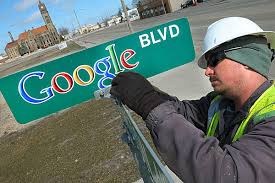
Some cities had used gimmicks to get the company’s attention. Topeka informally renamed itself “Google, Kansas.” A group in Baltimore launched a website that used Google’s mapping service to plot the location of more than 1,000 residents and give their reasons for wanting the service. Hundreds of groups on Facebook implored Google to come to their cities. The $70 monthly fee will pay for “gigabit” Internet service, about 100 times faster than a basic cable modem. For an additional $50 a month, Google will provide cable-TV-like service over the fiber, too, and a tablet computer that works as a remote.
The channel lineup includes Nickelodeon, Discovery, Bravo, Starz and Showtime (which may require additional fees) but is missing AMC, HBO, CNN, Fox News and ESPN. Google spokeswoman Jenna Wandres wouldn’t say why the channels were missing, but said the lineup would expand.
Google said it will start hooking up households in neighborhoods only where a sufficient number of people want service. Kansas City residents have six weeks to preregister for service, after which Google will decide which areas have enough interest.
Google will also offer a slower Internet option, at a DSL-like 5 megabits per second, with no monthly fee to households that pay a $300 installation fee. The free service is guaranteed for at least seven years, but is available only in neighborhoods where enough people have preregistered.
The $70 fee is more than what cable or phone companies charge for basic Internet service, but the service is also much faster. Gigabit speeds, or 1,000 megabits per second, are generally unavailable from other companies. One exception is the city-owned electric utility in Chattanooga, Tenn., which has pulled its own fiber and sells gigabit service for $350 a month.
Kansas City, Mo., Mayor Sly James, who attended the news conference Google held in a converted yoga studio in midtown Kansas City, was clearly pleased with the announcement.
“We now have an opportunity to take a giant step and if we don’t it’s all on us,” James said. “It’s going to be a great educational tool ... that’s going to create innovators and entrepreneurs, and that’s exactly what we want.”
There are few ways for consumers to take advantage of gigabit speeds. For everyday activities such as Web surfing, email and video-watching, there will most likely be no substantial difference. The higher speeds will help with video sharing and online backups.
Google is hoping that the network could help the development of other advanced applications that can take advantage of the high speeds. It’s also hoping to spur phone and cable companies into upgrading their own networks.
“Access speeds have simply not kept pace with the phenomenal increases in computing power and storage capacity that’s spurred innovation over the last decade,” Milo Medin, Google’s vice president of Access Services, said in a blog post.
However, it’s expensive to pull optical fiber compared with using existing phone and cable lines to provide Internet service. Verizon Communications is the only major U.S. telecommunications company to have connected homes directly to fiber. Wall Street analysts say that project, which has cost $23 billion, is not paying off.
Verizon has stopped adding new communities to its network, dubbed FiOS. It charges $70 a month for download speeds of 15 megabits per second, less than 2 percent the speed of Google’s gigabit.
Justin Venech, spokesman for Time Warner Cable, which provides service in Kansas City, said Thursday that he watched Google’s announcement online and said he didn’t see “too many things that jumped out at me beyond the speed.”
“Kansas City has been competitive for video and broadband services for a long time,” Venech said. “We offer advanced products and services today and we have experienced local employees delivering local services.”

